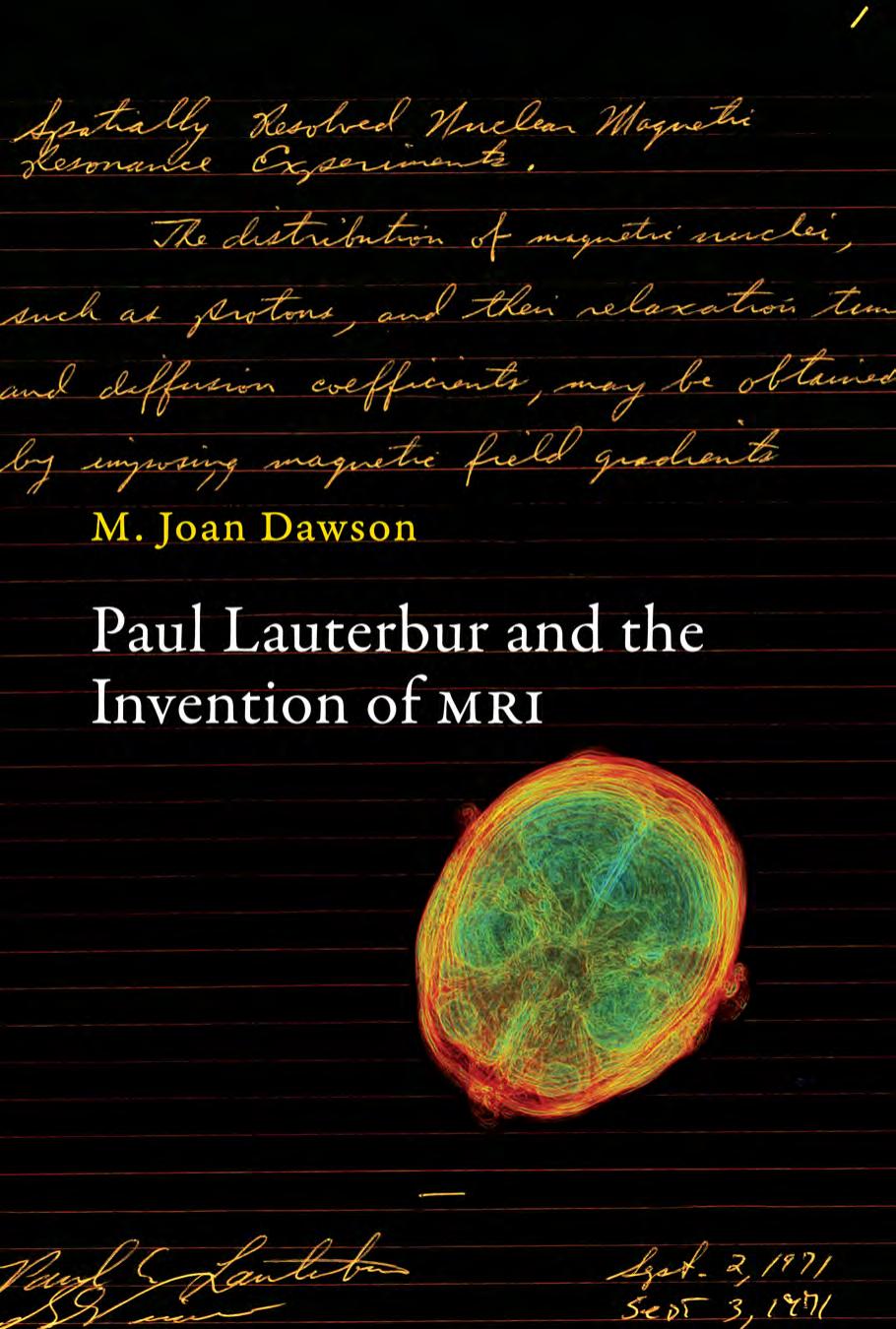
Paul Lauterbur and the Invention of MRI by M. Joan Dawson
Author:M. Joan Dawson [Dawson, M. Joan]
Language: eng
Format: epub, pdf
ISBN: 9780262019217
Publisher: The MIT Press
Published: 2013-08-22T04:00:00+00:00
Figure 7.1
Paul receives a site visit. Pictured are members of Paul’s lab and site visitors sent by the National Institutes of Health to evaluate the lab’s performance.
These first students explored as many different imaging methods as possible, and it is astounding how many different directions they pioneered. They worked together and learned from each other, under Paul’s overall guidance. The first objects to be imaged were chosen in part for their simple structures, which were not too taxing for the laboratory’s evolving methodology, and also for their size. Paul’s first work on capillary tubes and miniature clams had been done using an ordinary commercial NMR spectrometer that could accommodate objects no larger than 4 mm in diameter. He was a long way from the goal of human imaging.
By 1973 he had modified an instrument, a Varian DP-60, with a larger magnet gap. He came by this because Fairchild Industrial Products closed its laboratory on Long Island. Paul happened to know their NMR man, and the machine was donated to him. He and his students fitted together five crates worth of magnets, which had been shipped in pieces. They wound coils used to direct the magnetic energy, built their own radio receiving and transmitting coils, wrote computer programs, and hooked up a TV monitor to their contraption. Now pecans (the oil of the nutmeat was imaged rather than the water) were accessible, and so were a pine branch and the larger, delectable, cherrystone clams. They had their first patient noncompliance problem when a mouse refused to enter the sample tube. Mouse tails were big for a while and, a great milestone, the thorax of a mouse. Everyone remembers that mouse thorax well. It was more complex and biologically interesting than any of their other images, and they came away thinking, “Now we have seen the future.”
The group imaged eggplants, sweet peppers, and oranges, and then bigger objects such as coconuts and pork chops, all simple biological specimens that could be cut open to compare the image with the real thing. A detailed image of a green pepper caught the attention of everyone in NMR because its internal structure was clearly delineated. Paul’s postdoctoral fellow, Waylon House, explained: “We were hot. It was exciting. I had never seen anything before the green pepper that was really good, that was anything more than a blob.”7 Each new specimen was used to investigate further the characteristics of, or to solve problems inherent in, the imaging techniques to be used for human subjects and patients. They were then often eaten for lunch.
Big Red
Paul had calculated that human-scale magnets were possible, much to the skepticism of his colleagues. By 1975 his laboratory couldn’t make much more progress without a bigger magnet, preferably a human-sized magnet. To get one, he needed money. Paul finally raised funds to develop MRI technology from the National Cancer Institute, a part of the National Institutes of Health, and he ordered a magnet such as had never been built before. He was
Download
Paul Lauterbur and the Invention of MRI by M. Joan Dawson.pdf
This site does not store any files on its server. We only index and link to content provided by other sites. Please contact the content providers to delete copyright contents if any and email us, we'll remove relevant links or contents immediately.
Hit Refresh by Satya Nadella(9141)
When Breath Becomes Air by Paul Kalanithi(8451)
The Girl Without a Voice by Casey Watson(7892)
A Court of Wings and Ruin by Sarah J. Maas(7858)
Do No Harm Stories of Life, Death and Brain Surgery by Henry Marsh(6945)
Shoe Dog by Phil Knight(5274)
The Rules Do Not Apply by Ariel Levy(4975)
A Higher Loyalty: Truth, Lies, and Leadership by James Comey(4967)
Hunger by Roxane Gay(4933)
Tuesdays with Morrie by Mitch Albom(4791)
Everything Happens for a Reason by Kate Bowler(4746)
The Immortal Life of Henrietta Lacks by Rebecca Skloot(4593)
Millionaire: The Philanderer, Gambler, and Duelist Who Invented Modern Finance by Janet Gleeson(4482)
How to Change Your Mind by Michael Pollan(4361)
All Creatures Great and Small by James Herriot(4330)
The Money Culture by Michael Lewis(4212)
Man and His Symbols by Carl Gustav Jung(4142)
Elon Musk by Ashlee Vance(4130)
Tokyo Vice: An American Reporter on the Police Beat in Japan by Jake Adelstein(3998)
